First, let's discuss what SEO does. Search Engine Optimization plays an important role in increasing your online visibility, driving organic traffic, and generating qualified leads. Whether you are starting a micro-business or an enterprise, you need to make your business more visible online to gain more sales.
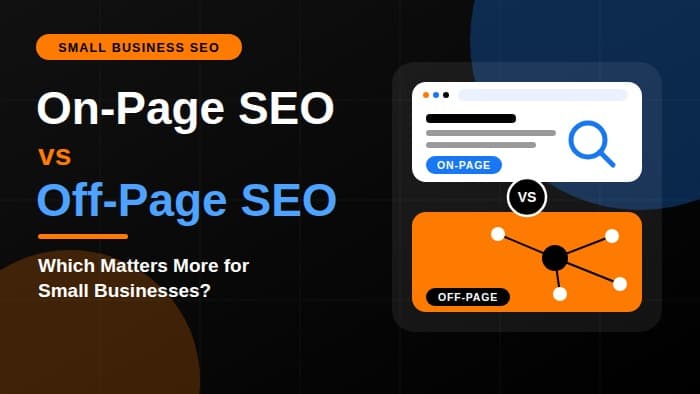
To do this properly, SEO is divided into three types: on-page, off-page, and technical SEO. The two most common types, which you are interested in, are the first two. On-page SEO is the practice of optimizing elements of your website, such as content, keywords, title tags, meta descriptions, headings, internal links, and page speed. In contrast, off-page SEO focuses on activities outside your website, including backlink building, brand mentions, social media engagement, and online reputation management.
However, many small business owners ask which type of SEO is good for their business. In this article, we will discuss On-page vs. Off-page SEO, their key differences, and which will suit your business.
What Is On-Page SEO?
On-page SEO involves improving the elements (text, images, and videos) of your website content to help search engines understand your content and improve your rankings in search results. The main purpose of this SEO is to make content more relevant, user-friendly, and search engine-friendly.
Think of it like this: you are making a dish and want it to be cooked perfectly. For this, you not only need the ingredients, but you should also know the right proportions of the ingredients to make it perfect. In the same way, SEO helps to improve every element of your website.
Let's understand SEO in detail:
Key Elements of On-Page SEO
It is important to learn the different elements of on-page SEO to understand its importance. These include:
1) High-Quality Content
You should understand the intent of your user to write creative, informative, and valuable content. For this, you must understand what your user is searching for and what your website is providing because adding irrelevant information can divert the reader's attention.
2) Keyword Optimization
Good content naturally contains relevant keywords. You can use them in headings, title tags, and meta descriptions. Using too many keywords in your content implies that you forcefully want your content to appear at the top of the SERP.
3) Title Tag
It is the main headline of your content that appears in search results. So, use the keyword in this title and keep it under 60 characters.
4) Meta Descriptions
It is the short summary below the title that does not directly affect the rankings, but an engaging one increases the click-through rate (CTR).
5) Headings (H1, H2, H3)
To improve the structure of your content, use proper heading tags to enhance readability and SEO.
6) URL Structure
A short and descriptive URL provides clarity and helps your website rank higher on the SERP.
7) Internal Linking
Use internal linking so that the visitor can visit other pages of your website and understand your content properly.
8) Image Optimization
If you are using images in your content, then add alt text to your images, which helps search engines crawl your site.
9) Page Speed
It shows how quickly your page appears to the user. Improve your website's loading speed to enhance user experience and search rankings.
10) Mobile Responsiveness
There are more mobile phone users than laptop or computer users, so ensure your website works well on all devices, especially smartphones and tablets.
Benefits of On-Page SEO for Small Businesses
There are several benefits of effective on-page SEO. Let's discuss some of them:
1) Better Search Engine Visibility
If you use relevant keywords and properly structure your content, Google will easily understand what your website is about, which increases the chances of your website ranking on SERPs.
2) Organic Traffic
Good on-page SEO drives more organic traffic to your website.
3) Better User Experience
If you organize your website with proper headings, the right structure, and relevant keywords, it helps users understand your website and keeps them engaged.
4) Increased Customers
It increases the chances of converting visitors into customers.
5) Better Content Indexing
It helps search engines understand and index your content more effectively.
What Is Off-Page SEO?
Off-page SEO refers to all optimization activities that are performed to enhance your website authority and credibility. Every element of On-page SEO is in your control, and you can optimize it as you wish. However, Off-page SEO isn't completely in your control.
Think of it like this: you have a restaurant, and you can make amazing dishes and keep it clean. That is On-page SEO. However, the reputation of your restaurant and how people think about your restaurant is what Off-page SEO is.
This SEO helps search engines determine how trustworthy and valuable your website is based on signals from other websites and online platforms.
Key Elements of Off-Page SEO
Now, let's understand the key elements of Off-page SEO:
1) Backlink Building
Backlinks are created when other websites link to your content. Always remember that quality is better than quantity, and one backlink from an authoritative website is a thousand times better than many backlinks from low-quality and spammy websites.
2) Brand Mentions
When another authoritative website shares your brand name without even sharing the link, it creates a good impression of your business authority. It is like a positive mention of your business.
3) Social Media Engagement
Although social media engagement does not directly increase rankings, it can increase brand awareness, drive traffic, and encourage users to interact with your business.
4) Guest Posting
If you write valuable content for other websites, you can gain quality backlinks and reach a wider audience.
5) Google Business Profile & Local Directories
It is important for small businesses to mention their name, address, and phone number (NAP) correctly on platforms such as Google Maps, Yelp, and local business directories. This helps improve your rankings.
6) Online Reviews
Good reviews from users increase trust and help your website rank higher in search engines.
Benefits of Off-Page SEO for Small Businesses
Understanding the importance of this SEO is easy. Off-page SEO helps improve the reputation of your website, pages, and content. It is the marketing that makes your business appear trustworthy among people. Therefore, this SEO helps your website grow and perform better in search engines.
On-Page SEO vs Off-Page SEO: Key Differences
We have discussed On-page SEO and Off-page SEO in detail. Now, let's discuss their differences:
1) Area of Focus
On-page SEO controls and optimizes the elements on your website, whereas Off-page SEO focuses on external activities that improve your website.
2) Main Purpose
On-page SEO plays an essential role in improving content quality, website structure, and user experience. On the other hand, Off-page SEO improves your website's reputation.
3) Key Activities
On-page SEO involves keyword optimization, title tags, meta descriptions, headings, internal linking, image optimization, and page speed. In contrast, Off-page SEO includes backlink building, brand mentions, guest posting, social media engagement, Google Business Profile, and online reviews.
4) Level of Control
All aspects of On-page SEO are under your control, whereas Off-page SEO is not completely under your control because it depends on external sources.
5) Impact on Search Engines
On-page SEO helps search engines understand your website, whereas Off-page SEO helps search engines determine your website's authority and trustworthiness.
6) Time to See Results
On-page SEO delivers faster results than Off-page SEO.
Comparison Table: On-Page SEO vs Off-Page SEO
|
On-Page SEO |
Off-Page SEO |
|
Focuses on optimizing the elements within your website. |
Focuses on activities performed outside your website. |
|
Improves content quality, website structure, and user experience. |
Improves website authority, credibility, and online reputation. |
|
Includes keyword optimization, title tags, meta descriptions, headings, internal linking, and page speed. |
Includes backlink building, brand mentions, guest posting, social media engagement, and online reviews. |
|
Gives you complete control over optimization. |
Is not completely under your control because it depends on external sources. |
|
Helps search engines understand your content. |
Helps search engines determine your website's trustworthiness and authority. |
|
Usually delivers faster results after implementation. |
Usually takes more time to show results because it depends on building authority over time. |
|
Forms the foundation of every successful SEO strategy. |
Strengthens your website's reputation and supports long-term rankings. |
Which Matters More for Small Businesses?
Now comes the most important question: Which matters more for small businesses? On-page and Off-page SEO are not competitors, but they complement each other to improve the performance of your website.
Think of it like this: one person builds the restaurant and takes care of everything required to run it, while the other takes care of the restaurant's reputation. In the same way, On-page SEO builds and optimizes your website, while Off-page SEO builds its authority and trust.
However, if you are starting a new business or have a newly launched website, you should prioritize On-page SEO first. Once your website has quality content and a strong foundation, you can focus on Off-page SEO to build authority and improve your rankings.
Conclusion
For small business owners, you can make your business more visible with the help of On-page and Off-page SEO. Both have different roles, and you cannot choose only one to improve your website's visibility on search engines. One helps improve the elements and different aspects of your website, while the other works outside your website to improve its authority and credibility. Even a well-optimized website can fail to rank well due to a lack of proper Off-page SEO.
To get premium SEO services, you can trust Marketing by Dyprocs Media Marketing.
FAQs
Frequently Asked Questions
Both are important because one optimizes all the elements of your website, while the other improves your website's reputation, authority, and credibility.