Your company needs to partner with a trusted SEO organization to get the best SEO services. If you want your business to become visible, generate highly qualified leads, and increase sales, your website should be well-structured, easy to navigate, and provide valuable information that matches what users are searching for.
In this case, On-Page SEO assists you. It optimizes the elements of your website, such as content, keywords, title tags, headings, URLs, images, and page speed, to improve your visibility on search engines. Unlike Off-Page SEO, which depends on external factors, On-Page SEO gives you complete control over how your website is optimized.
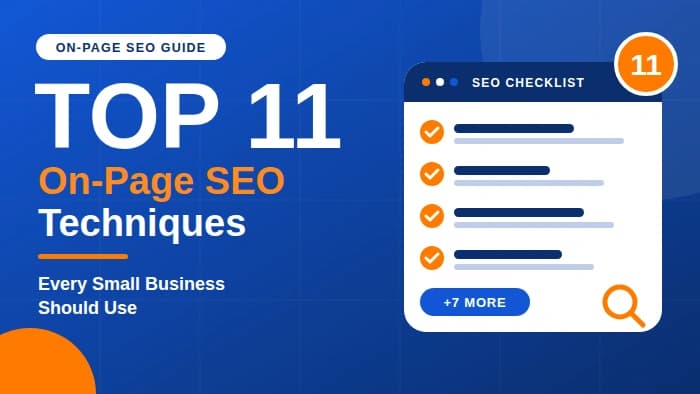
In this article, we will explore the top 11 On-Page SEO techniques every small business should use to improve search rankings, attract more organic traffic, and provide a better experience for website visitors.
What Is On-Page SEO?
On-Page SEO is the process of optimizing all the elements of your website to help search engines and users understand your content. It involves optimizing both the content and the HTML source code of a webpage to make it more relevant, user-friendly, and search engine-friendly.
The main goal of On-Page SEO is to provide valuable and informative content according to users' search intent. To make it simpler, you might have prepared a school project at some point in your life. To complete that project, you needed different materials and techniques. Similarly, On-Page SEO uses different techniques to improve your website. The best part is that On-Page SEO is completely under your control, which means you can optimize and improve your website whenever needed.
Why On-Page SEO Matters for Small Businesses
On-Page SEO is more important for startups because, in the beginning, many business owners do not know how to create a good website and optimize its elements. Also, investing heavily in advertisements is not possible for many small businesses. On-Page SEO improves every aspect of your website, such as keywords, URLs, HTML, headers, images, videos, and more. This improves your small business's online presence.
By optimizing your website properly, search engines can better understand your content and rank it higher in search results. With On-Page SEO, your small business can compete with larger brands.
Top 11 On-Page SEO Techniques Every Small Business Should Use
1) Create High-Quality Content
Your content should be good, informative, and helpful. It should be created in a way that helps your users. Sometimes a user is searching for a product or just looking for information, so try to create original content that only assists and does not make your customers bored or tired while searching for the desired answer.
You should also avoid copying content from other websites, as it can negatively affect your rankings.
2) Use Effective Keyword Research
Your first step toward creating content should be keyword research. Try to find relevant keywords, check their search volume, and naturally include them in your content. A keyword is a word or a group of words that a person searches for on search engines.
Good keyword research and proper keyword usage in the meta title, meta description, introduction paragraph, subheadings, and URLs are essential for good On-Page SEO. They help both users and search engines find your webpage.
3) Optimize Title Tags and Meta Descriptions
The first things from your page that appear on the search engine results page are your meta title and meta description. They clearly define what your content is about. It is wise to create clear, engaging, and keyword-rich titles that encourage users to click on your website. They are like a banner on a shop that indicates what the shop is selling.
4) Use Proper Heading Tags (H1, H2, H3)
Heading tags provide the structure to your content, making it easy for a reader to find what information is given. Without heading tags, your content looks lengthy, and the real information can be missed. Think of it like this: you are reading about the types of shoes, and there are no heading tags. So, how would you know which information is about running shoes and which is about gym shoes?
For this, use the H1 tag for the main title, followed by H2 and H3 tags for subheadings. A well-structured page improves readability.
5) Create SEO-Friendly URLs
If you want your webpage to rank at the top, you are required to create short, descriptive, and easy-to-read URLs. It is also essential to include relevant keywords in your URLs and avoid unnecessary numbers, symbols, or long strings of text. Search engines can easily read and understand clear URLs and better understand your webpage.
6) Improve Internal Linking
You can help search engines crawl your website more effectively if you use internal links in your content. Internal links connect one page of your website to another page. In this way, readers can also visit other pages on your website to find relevant information. It also improves navigation and distributes authority across your website.
7) Optimize Images for SEO
If you use images in your blog, they make your content visually appealing. However, the key is to use images properly. For this, use relevant images, add descriptive file names, include relevant alt text, compress image sizes to improve loading speed, and choose high-quality images that support your content.
8) Make Your Website Mobile-Friendly
There are more mobile phone users than laptop and computer users. Therefore, it is important to make your website mobile-friendly so that it can adjust to different screen sizes and make it easier to navigate and read. Google also prioritizes mobile-friendly websites, making this an essential On-Page SEO technique.
9) Focus on Search Intent
It plays a very important role in understanding the intent of your customers. If you know what your audience is going to search for, you can create content that meets their needs. For example, if they search for "why is my AC leaking," they want a solution. If they search for "AC repair service in Karachi," they want to hire someone. Tailor your content to meet that exact need.
10) Add Schema Markup
Schema markup is a type of structured data that helps search engines understand your content more accurately. It displays rich snippets such as ratings, FAQs, reviews, prices, and business information, making your website more attractive to users. It also allows search engines to crawl and understand your website more easily.
11) Prioritize Page Speed
It is important for your content to load quickly because users do not prefer to visit website pages that take a long time to load. To improve page speed, compress images, remove unnecessary code, enable browser caching, and use reliable web hosting.
Best On-Page SEO Tools for Small Businesses
If you use the right tools to optimize your website, content, and webpages, you can achieve better results, and the optimization process becomes easier and more effective. Some of the best On-Page SEO tools for small businesses include:
- Google Search Console
- Google Analytics 4
- Rank Math
- Ahrefs
- SEMrush
- Screaming Frog
- Google PageSpeed Insights
- Moz Pro
- Surfer SEO
- SE Ranking
Conclusion
This article has definitely proved to be an ocean of knowledge for small businesses. We have discussed the top 11 On-Page SEO techniques that help optimize your content to become more visible on search engines, generate highly qualified leads, and increase sales. It is also helpful for anyone planning to start a new business, as you can choose the right company that provides quality On-Page SEO services. Sometimes, cheap SEO agencies fool people by selling only a few services at a high price.
FAQs
Frequently Asked Questions
Some of the best On-Page SEO techniques are creating high-quality content, performing effective keyword research, optimizing title tags and meta descriptions, using proper heading tags (H1, H2, and H3), creating SEO-friendly URLs, improving internal linking, optimizing images, increasing page speed, making your website mobile-friendly, focusing on search intent, and adding schema markup.